

Mill Creek Sink Nature Preserve (Alachua Sinks)
KEY STATS
Alachua County, Florida
1993
>1500 ft
In 1993, the NSS accepted the donation of Mill Creek Sink, which is a completely water-filled cave. The surface stream system is dissected by more than 10 swallow holes that divert water underground, draining a basin of more than 70 square miles. The sinkhole slopes steeply nearly 50 feet down to the water’s edge. The sinkhole is filled with very dark, tannic-stained water for most of the year, as well as fallen trees and debris. Clear water is not encountered for a considerable distance into the system. The main cave system has tunnel both upstream and downstream with depths known to 227 feet.
We Need Your Help!
Mill Creek Sink Nature Preserve is under imminent threat from surrounding proposed development that could introduce contaminated stormwater into the system and degrade ground water. Learn more and find out how to donate to protect Mill Creek!
Want to Visit?
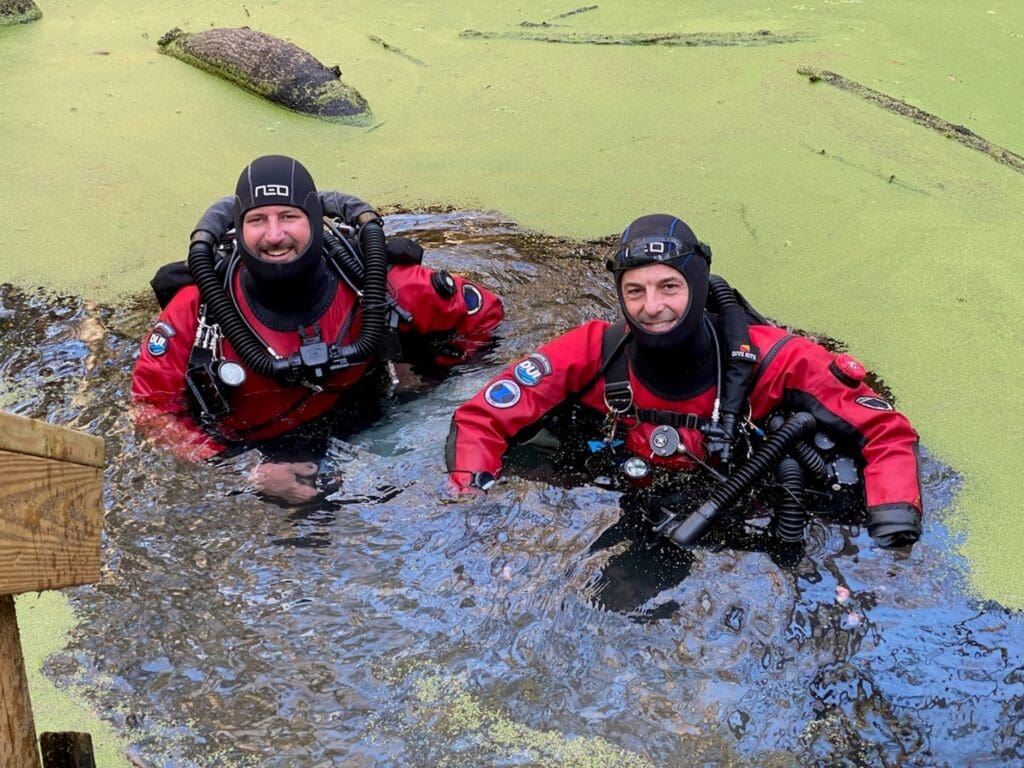
Access to the preserve is limited to qualified cave divers only. Visitation will only be permitted for research, data collection, water sampling, or survey. No training activities are allowed. All visitors must contact [email protected] for activity approval prior to requesting a permit.


Mill Creek Sink is home to turtles, both soft-shell and snapping varieties. Alligators are occasionally seen also. Brim and catfish are seen in the basin and catfish have been spotted throughout the cave system. Blind cave crayfish, the Pallid Cave crayfish (Procambarus pallidus), the Florida Cave Amphipod (Crangonyx grandimus) and the Hobb's Cave Amphipod (Crangonyx hobsi) are also found in the cave and are "species of special concern" designated by the State of Florida. The Florida Committee on Rare and Endangers Biota of Florida has published the selected information for State of Florida Game and Freshwater Fish Commission. This information supports and recommends protection of these and other related cave species.
Mill Creek Sink lies along a persistent topographical feature known as the Cody Escarpment. This westward-facing escarpment is the erosional boundary between an upland plateau to the east and a karst plain to the west. The upland plateau, with elevations up to the 190 feet mean sea level (MSL), is known as the Hawthorne Plateau or the Northern Highlands. The plateau once extended completely across Alachua County, and is composed of marine and deltaic sediments. Karst features are scarce on the plateaus due to the impervious clays of the Hawthorne Formation. The plateau landscape is characterized by very low relief, which along with a high water table forms swampy pine flatwoods and cypress ponds.
Retreat of the escarpment has exposed the underlying limestone sediments of the karst plain, which were reduced to their present topographically low level (less than 75 feet MSL) through the action of solution and modified by the Pleistocene higher sea level stands. Small short caves, solution pipes, and cenote like sinkholes are common on the karst plain.
The site consists of 8.8 acres of land, most of which lies below the 100 year flood plain, and thus has very little commercial development potential. However, there is a 50-foot wide section of land to the east of the sinkhole, which comes out to front on US Hwy. 441. It is important to note that the Mill Creek Sink property does not include any land on the high ground west of the sinkhole. All of the property between the sinkhole and Sonny's BAR-B-Q is privately owned. The property is managed for diving, research, and educational purposes and both the committee members and the Alachua Police Department monitors its use.
Mill Creek Sink is a water-filled sinkhole connected to a water filled cave located near I-75 in the city of Alachua, Florida. Mill Creek Sink is the only known window to the underground Mill Creek Stream System. The sinkhole slopes steeply nearly 50 feet down to the water's edge. Most of the year the sinkhole is filled with very dark, tannic-stained water as well as fallen trees and debris. Clear water is normally not encountered for a considerable distance into the system. The main cave system has tunnel both upstream and downstream with depths to 227 feet.
The surface stream, Mill Creek and Townsend Branch, drains over 70 square miles north of Mill Creek Sink and is dissected by over 10 swallow holes. Mill Creek Sink is the only known window that allows access to the underwater cave. There is a swallow hole located north of the main sinkhole, which provides an in feeder of surface runoff into the system. The other sinks are alluviated to the extent that the investigators cannot extend them.
Underground dye tracing studies done by the NSS-CDS in February of 1976 and 2006 revealed that Mill Creek Sink is connected to Hornsby Springs, a straight line distance of six miles. Hornsby Springs is a tributary water source for the Santa Fe River. The Santa Fe River is designated as an "Outstanding Florida Waterway" which is the most prominent designation for a river in the State of Florida. The uniqueness of this hydrological relationship provides an upstream karst window to a sensitive water source, which is part of a major conduit feeding the Florida Aquifer. Further understanding of the hydrology of Mill Creek Sink is needed and can be gained through exploration and survey of the system. Protection from point and non-point pollution is the primary reason in favor of NSS ownership. Additionally, NSS ownership with local management by the Mill Creek Sink Management Committee (MCSMC) would provide the basis for ongoing field study in this area.
Access to the system will be limited to qualified cave divers only due to the nature and complexity of the underwater cave system. Visitation will be permitted for research, data collection, water sampling, and survey/mapping. No training activities are allowed. See the Management Plan for detailed Access Rules prior to applying for a permit online.
If you have questions about this Preserve, email: [email protected].
